Types of abscess around the anus, and how soon to get care
Draft awaiting clinical review by Dr Wong. Published . 6 min read.
An anorectal abscess is a pocket of pus near the anus, named by the space it forms in. Perianal abscesses sit just under the skin and are usually reported as the most common type, about four in ten in the largest older series. Deeper types can show little on the skin. Most need draining, because antibiotics alone rarely clear pus.
What are the types of anal abscess?
Anal abscesses are named by where the pus collects. A perianal abscess lies under the skin at the anal edge, an ischioanal abscess in the fat beside the anus, an intersphincteric abscess between the two sphincter muscles, and a supralevator abscess above the pelvic floor muscle. Most begin in a blocked, infected anal gland.
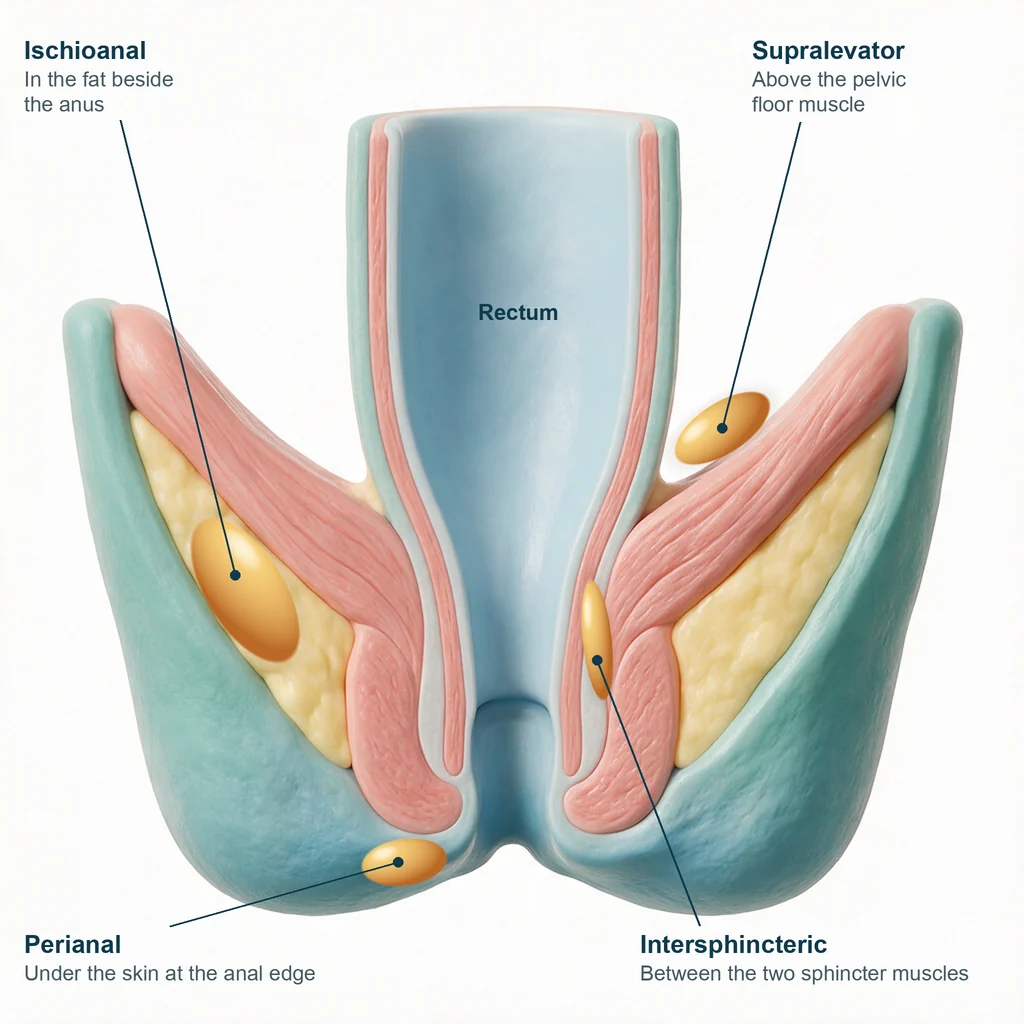
| Type | Where it forms | How it often feels | Usual treatment |
|---|---|---|---|
| Perianal | Under the skin at the anal edge | Constant throbbing pain and a red, tender lump, worse when sitting or passing stool | Incision and drainage |
| Ischioanal (ischiorectal) | In the fat beside the anus and lower rectum | Pain and swelling further from the anus, sometimes broad across the buttock | Incision and drainage |
| Intersphincteric | Between the inner and outer sphincter muscles | Deep pain in the back passage with little or nothing to see | Drainage planned around the sphincter muscles |
| Supralevator | Above the pelvic floor muscle | Pain in the pelvis, low back or buttock, with fever and little to see outside. Scans are often needed | The drainage route depends on where the infection started |
| Horseshoe | Crosses the midline, usually behind the anus. Not shown in the picture | Severe deep pain, often on both sides | Specialist drainage. The risk of it coming back is higher |
Why can a deep abscess show nothing on the skin?
A deep abscess sits behind muscle and fat, so the skin can look normal while the pain is severe. Intersphincteric and supralevator abscesses are the usual examples. Pain may be felt in the back passage, lower back or buttock, and a scan or an examination under anaesthesia may be needed to find one.
What else can look like an anal abscess?
Three other conditions cause painful lumps in the same area but start elsewhere and are managed differently. They are a pilonidal abscess at the top of the buttock crease, a Bartholin's abscess beside the vaginal opening, and hidradenitis suppurativa, which causes repeated lumps in skin folds. A clinician can examine the area and may need further tests to work out the cause.
| Condition | Where | How it often feels | Usual management |
|---|---|---|---|
| Pilonidal abscess | Top of the crease between the buttocks | Sudden painful swelling that may leak pus or blood and makes sitting hard | Incision and drainage, then hair control or surgery if it keeps returning |
| Bartholin's abscess | Beside the vaginal opening | A painful swelling, and sometimes feeling unwell with a high temperature | Depends on the swelling and may include antibiotics or drainage. A gynaecologist usually manages this |
| Hidradenitis suppurativa | Skin folds such as the groin, armpits, buttocks and around the anus | Painful lumps that keep returning and leaking, with channels under the skin | Long-term care with medicines, and surgery if severe |
How soon should I be seen? A symptoms checklist
This list helps you decide how soon to be seen. It cannot tell you what you have. Several conditions look alike, some deep abscesses show nothing on the skin, and a serious infection can look minor at first. If you are unsure which list fits you, use the more urgent one.
If you have pain, swelling or bleeding in or around the anus, genitals or buttocks, call 995 or go to an emergency department now if you have any of these, even if you cannot see a lump
- Confusion, slurred speech, or being very hard to wake
- Very fast breathing or difficulty breathing
- Blue, grey, pale or blotchy skin or lips
- Uncontrollable shivering, or a very high or very low temperature
- Suddenly being unable to pass urine when you need to, or passing no urine all day or very little over many hours
- Pain far worse than the skin looks
- Skin turning dark, purple or black, blisters, or a crackling feeling under the skin
- Redness or swelling spreading quickly, including towards the groin, scrotum, labia or lower tummy
- Heavy bleeding from the anus, large blood clots, or bleeding that does not stop
- Chemotherapy now or recently, with a temperature of 38°C or higher, chills or feeling unwell. Contact your cancer team immediately or go to an emergency department, and follow any lower temperature limit your team has given you
Be seen the same day, if you have any of these
- A red, tender or swollen lump near the anus or between the buttocks
- Constant throbbing pain that stops you sitting
- New deep pain in or near the anus, or unexplained deep pain in the pelvis, lower back or buttocks that is severe, getting worse, or comes with fever or feeling unwell, even if no lump is visible
- New or worsening pus, or a small amount of blood, leaking from near the anus
- Severe pain near the anus with fever or chills
- Any of the above with diabetes, Crohn's disease or ulcerative colitis, or a weak immune system from chemotherapy, steroids, transplant medicines or HIV
Book a routine visit, if you have any of these
- A small hole near the anus with a stable, long-standing discharge, or one that keeps coming back, without new or worsening pain, swelling, fever or heavy bleeding. It may be a fistula
- Painful lumps that keep returning in the groin, armpits or buttocks
- A painless lump near the anus. It still needs checking
Children can show different warning signs. If a child seems very unwell, call 995. If a baby under 3 months has a temperature of 38°C or higher, go to an emergency department now, even if the baby does not appear very unwell. A clinic is not an emergency service, so use 995 or an emergency department for anything on the first list.
How is an anal abscess treated?
The main treatment is incision and drainage, a procedure that lets the pus out. Antibiotics alone rarely clear a collection of pus. They are added for spreading skin infection, signs of infection in the whole body, or a weak immune system. Drainage is usually done soon after diagnosis, and results vary between patients.
Packing the wound is not always needed. Your surgeon decides what suits your wound.
Can an abscess come back or leave a fistula?
Yes. According to the American Society of Colon and Rectal Surgeons, 30 to 70% of people with an anorectal abscess already have a fistula when they first present, and 30 to 50% of the others are later found to have one. An abscess can return in up to 44%, mostly within a year.
A fistula is a small tunnel between the anal canal and the skin. Follow-up after drainage helps find one. An abscess that keeps returning, or a complex one, can also prompt a check for Crohn's disease.
What should I avoid doing?
Do not squeeze a lump or try to drain it yourself, and do not rely on leftover antibiotics. Simple pain relief and warm baths may ease discomfort while you arrange to be seen, but they do not treat the pus, so they are not a reason to wait if a list above applies to you. If you are having or have recently had chemotherapy and feel unwell or feverish, contact your cancer team before taking pain relief.
Sources
- ASCRS Clinical Practice Guidelines: Anorectal Abscess, Fistula-in-Ano and Rectovaginal Fistula, 2022
- Ramanujam et al: Perianal abscesses and fistulas, 1,023 patients, 1984
- Read and Abcarian: Anorectal abscess, 474 patients, 1979
- ASCRS Clinical Practice Guidelines: Pilonidal Disease, 2019
- StatPearls: Perianal Abscess
- StatPearls: Fournier Gangrene
- NHS: Sepsis
- NHS: Anal pain
- NIDDK: Urinary retention
- National University Cancer Institute, Singapore: Chemotherapy side effects
- NHS: Pilonidal sinus
- NHS: Bartholin's cyst
- NHS: Hidradenitis suppurativa

Written for patients of Dr Wong Nan-Yaw
MBBS (NUS), FRCS (Edinburgh). 33 years in medicine (since 1993), 23 years as an accredited specialist (since 2003) and 18 years in private practice at Mount Elizabeth (since 2008). Content updated 2026-11-07. Awaiting Dr Wong's clinical review.
How this article is prepared
Statements are checked against the sources listed above. This article is general education and does not replace a consultation. It is reviewed and updated when guidance changes. In an emergency, call 995.